If you’re a coach, health coach, business coach, life coach, fitness coach, or any kind of transformation-focused expert, you’ve probably faced this challenge:
You want more clients, but you don’t want to feel pushy, aggressive, or salesy.
Most coaches genuinely care about people. You want to guide, help, and empower, not pressure someone into buying.
But here’s the truth:
You still need a predictable system that turns your expertise into consistent revenue.
But here’s the truth:
You still need a predictable system that turns your expertise into consistent revenue.
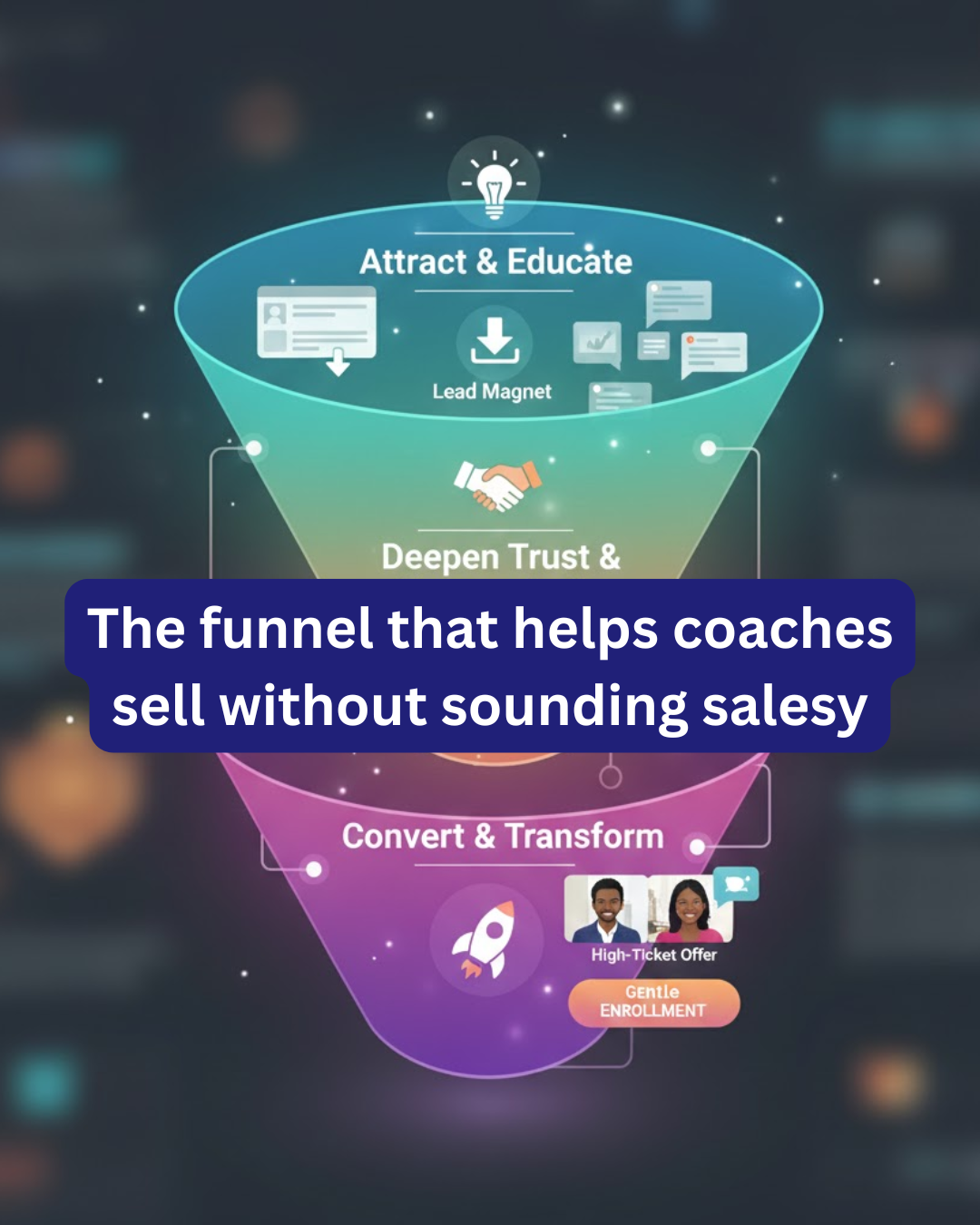
That’s where a relationship-first funnel comes in, a funnel designed to sell without sounding like you’re selling.
Let’s break down how this works.
1. Awareness: Make People Feel Seen, Not Targeted
Salesy marketing begins when you shout your offer into the void.
A non-salesy funnel does the opposite: it starts by understanding your audience deeply.
A non-salesy funnel does the opposite: it starts by understanding your audience deeply.
At this stage, your content should:
- Name their struggles clearly.
- Reflect back their unspoken thoughts.
- Offer insights that immediately help.
- Create micro-transformations through education.
You’re not saying, “Buy my coaching.”
You’re saying, “I understand what you’re going through.”
You’re saying, “I understand what you’re going through.”
This instantly builds trust.
Examples of awareness content:
- “Why do you feel stuck even though you’re doing everything right”
- “3 patterns that block progress and how to break them”
- “Why motivation fails you and what actually works.”
The goal isn’t to close a sale.
The goal is to open a conversation.
The goal is to open a conversation.
2. Lead Magnet: Give Value Without Asking for Commitment
Most coaches think a lead magnet is something fancy.
It’s not.
It’s simply a small, high-value resource that helps someone take their next step.
It’s not.
It’s simply a small, high-value resource that helps someone take their next step.
Your lead magnet should:
- Be easy to understand
- Solve a real problem.
- Deliver quick wins
- Showcase your unique method.
- Build credibility
Examples:
- A mini audit
- A short checklist
- A 10-minute training
- A “first-step” workbook
This positions you as a guide, not a salesperson.
3. Nurture: Build Trust Through Story, Value, and Proof
This is the heart of a non-salesy funnel.
Most coaches lose leads here because they are either:
❌ Sell too fast
❌ Don’t follow up
❌ Overwhelm people
❌ Don’t follow up
❌ Overwhelm people
A trust-based nurture sequence (email, WhatsApp, or DMs) should include:
• Valuable insights
Things that help them think differently.
• Relatable stories
People buy from people who understand them.
• Small wins
“Do this today” style action steps.
• Belief shifts
Show what’s possible.
• Social proof
Without bragging, just honest transformation examples.
This is where you earn the right to talk about your offer later.
4. Soft Invitation: Show a Path, Don’t Push a Sale
A good funnel doesn’t say:
“Book now before it’s too late!”
Instead, it gently invites:
“If you’d like help implementing this, here’s how I can support you.”
This shifts the conversation from:
selling → helping
pushing → guiding
pressure → clarity
pushing → guiding
pressure → clarity
Examples of non-salesy invitations:
- “If you want personalized support, you can apply for a clarity call.”
- “If this resonates, I’d love to help you map out your next steps.”
- “If you’re curious about coaching, here’s how my program works.”
The focus stays on your client’s needs, not your agenda.
5. The Offer: Make It About Their Transformation, Not Your Features
When it’s time to present your coaching program:
- Speak about outcomes
- Show the journey
- Explain the methodology
- Highlight who it’s for
- Be transparent
- Remove confusion
- Add proof
A non-salesy offer clearly communicates:
- What they get
- What changes
- Why it works
- Who it’s designed for
You’re not “selling coaching.”
You’re offering a solution that aligns with their goals.
You’re offering a solution that aligns with their goals.
6. Follow-Up: Gentle, Consistent, Value-Based
Most people don’t buy instantly.
Coaches who succeed at non-salesy selling do this:
- Follow up without pressure.
- Add value each time
- Respect boundaries
- Give space to think
- Stay visible and helpful.
You don’t need to chase clients.
You need to stay relevant.
You need to stay relevant.
The Funnel That Never Feels Salesy?
It’s simple:
Awareness → Value → Nurture → Invitation → Offer → Follow-Up
A funnel built on empathy, clarity, and trust will always outperform aggressive selling.
Because people don’t buy coaching from tactics.
They buy coaching from a connection.
They buy coaching from a connection.