In today’s fast-paced healthcare environment, clear communication is just as important as clinical expertise. Patients often feel overwhelmed by medical terminology, complicated diagnoses, and unclear treatment plans. This communication gap not only increases anxiety but also affects treatment compliance and overall patient satisfaction. As technology advances, artificial intelligence (AI) is emerging as a powerful tool to help doctors translate complex medical information into simple, understandable language.
AI isn’t here to replace doctors. It’s here to support them, especially when it comes to improving clarity, education, and patient trust.
The Challenge: Medical Language vs. Patient Understanding
Doctors spend years mastering intricate medical concepts. But patients encounter them for the first time during some of the most stressful moments of their lives. Terms like “angioplasty,” “endocrine dysfunction,” or “autoimmune response” may feel routine for clinicians but can be confusing or intimidating for patients.
This disconnect can lead to:
- Misunderstanding of diagnosis
- Fear or anxiety
- Hesitation to ask questions
- Poor treatment compliance
- Lower trust in the healthcare system
AI tools can bridge this communication gap by transforming complex data into clear, relatable explanations.
How AI Helps Simplify Medical Explanations
1. AI Converts Medical Jargon Into Patient-Friendly Language
AI systems can take detailed clinical descriptions, lab results, or medical reports and rewrite them in simple, everyday language. Instead of saying “You have hyperlipidemia,” AI can help produce a clearer explanation like:
“Your cholesterol levels are higher than normal, which means fat is building up in your blood.”
“Your cholesterol levels are higher than normal, which means fat is building up in your blood.”
This makes discussions less intimidating and empowers patients to understand their health better.
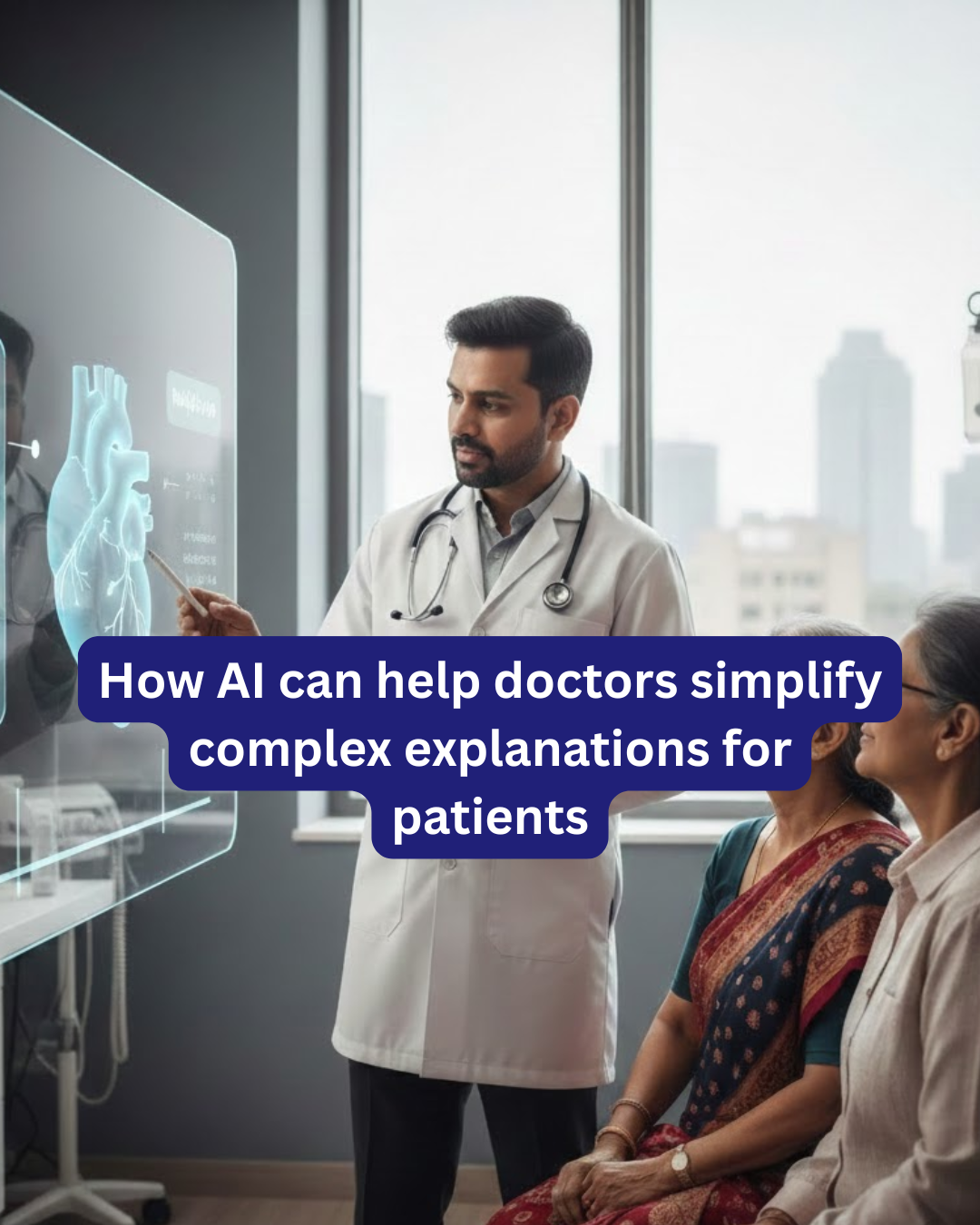
2. AI Creates Visual Aids for Better Understanding
Many patients learn better visually. AI can generate:
- Diagrams of body systems
- Illustrations of procedures
- Progress charts
- Personalized visuals showing improvements or risks
When patients see what’s happening, they understand it faster and more accurately.
3. AI Helps Doctors Personalize Explanations
Every patient is different age, literacy level, culture, and emotional state, all affect how they understand information.
AI can analyze patterns and help create explanations tailored to:
- A child vs. an adult
- A first-time patient vs. someone with a chronic illness
- A patient with high anxiety vs. someone more analytical
This personalization leads to better retention and stronger patient-doctor relationships.
4. AI Assists With Multilingual Communication
Language barriers often make medical care difficult. AI-powered translation tools help doctors explain diagnoses and treatment plans in the patient’s preferred language without losing meaning.
This improves:
- Patient comfort
- Informed consent
- Treatment accuracy
- Trust and engagement
5. AI Streamlines Patient Education Materials
AI can quickly generate brochures, FAQs, aftercare instructions, and medicine explanations that are easy to read. Instead of handing out dense paragraphs filled with medical jargon, doctors can provide clear, simple, and personalized documents in minutes.
The Benefits: Why AI-Supported Explanations Matter
When patients understand their health better, everything improves.
Better compliance: Patients follow treatment plans more consistently when they understand why it matters.
Higher satisfaction: Clear communication reduces stress and builds trust.
Improved outcomes: When patients make informed decisions, their health improves faster.
More efficient consultations: Doctors save time by using AI to prepare clear explanations quickly.
Reduced misunderstandings: Fewer errors, less confusion, and stronger relationships.
Higher satisfaction: Clear communication reduces stress and builds trust.
Improved outcomes: When patients make informed decisions, their health improves faster.
More efficient consultations: Doctors save time by using AI to prepare clear explanations quickly.
Reduced misunderstandings: Fewer errors, less confusion, and stronger relationships.
What AI Cannot Replace
AI supports communication, but the human touch remains essential.
Patients still need empathy, reassurance, and personalized guidance from their doctor.
Patients still need empathy, reassurance, and personalized guidance from their doctor.
AI is a tool doctors are the healers.
The Future: Smarter, Simpler, More Connected Healthcare
As AI continues to evolve, it will offer even more ways for doctors to communicate effectively, from personalized videos to AI-powered chatbots that answer patient questions after appointments.
But the goal remains the same:
Make healthcare easier to understand, so patients feel informed, confident, and cared for.
Make healthcare easier to understand, so patients feel informed, confident, and cared for.
By using AI to simplify complex explanations, doctors not only save time but also elevate the quality of patient care one clear conversation at a time.