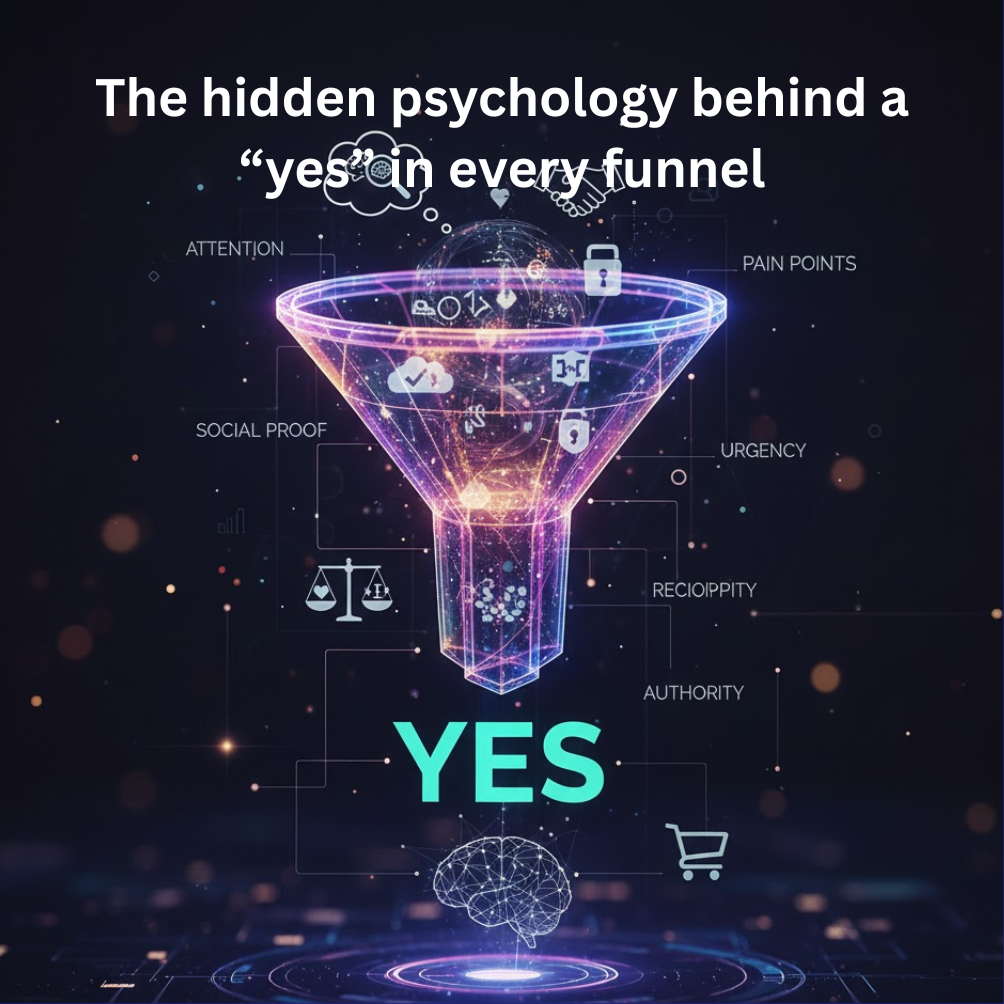
Every high-converting funnel has one thing in common: it understands human psychology. Funnels are not just pages, buttons, or emails. They guide the human brain toward trust, clarity, and action.
Behind every “yes,” whether it’s a booked consultation, a download, or a purchase, certain psychological triggers are at work. When you understand these triggers, your funnel becomes more than a series of steps. It becomes a predictable influence system.
Here’s the hidden psychology that makes people say “yes” inside a strong funnel.
1. The Brain Says Yes to Simplicity
Cognitive load is the enemy of conversions.
When people feel overwhelmed, they stop taking action.
When people feel overwhelmed, they stop taking action.
Great funnels:
- remove clutter
- simplify choices
- Use short sentences
- guide the eye clearly
- offer one action at a time
The human brain prefers the easiest path.
A simple funnel reduces friction, and friction kills conversions.
A simple funnel reduces friction, and friction kills conversions.
2. People Say Yes When They Feel Understood
Before prospects trust you, they need to feel seen.
The best way to do that is to mirror their thoughts.
Effective funnels reflect:
- fears
- frustrations
- goals
- aspirations
When someone reads your message and thinks, “That’s exactly what I’m dealing with,” they instantly connect.
People engage when they feel understood.
3. Authority Lowers Risk and Encourages Yes
People say yes when they feel safe.
Authority creates that safety.
Authority creates that safety.
A funnel builds authority with:
- credentials
- experience
- certifications
- media mentions
- testimonials
- case studies
Authority reduces perceived risk.
Lower risk leads to higher conversions.
Lower risk leads to higher conversions.
4. Social Proof Triggers Action
People trust what others have already approved.
This is why strong funnels include:
This is why strong funnels include:
- testimonials
- screenshots
- video reviews
- before-and-after stories
- client success numbers
When prospects see others succeed, they believe they can too.
5. Scarcity Encourages Immediate Action
Scarcity creates urgency.
Urgency creates movement.
Urgency creates movement.
People fear missing out more than making the wrong choice.
Real scarcity inside a funnel includes:
- limited-time bonuses
- countdown timers
- limited seats
- enrollment windows
Scarcity works only when it’s truthful.
Fake urgency breaks trust.
Fake urgency breaks trust.
6. People Say Yes When They See Their Future Self
A powerful funnel helps people visualize a better version of themselves.
Examples:
“Imagine waking up without pain.”
“Picture growing your business with confidence.”
“What would life look like if this problem were solved?”
“Imagine waking up without pain.”
“Picture growing your business with confidence.”
“What would life look like if this problem were solved?”
Seeing the future creates emotional motivation.
And emotions drive buying decisions.
And emotions drive buying decisions.
7. Micro-Commitments Build Momentum
A big “yes” usually comes after a series of small yeses.
Funnels create micro-commitments such as:
- clicking a button
- watching a short video
- answering a simple question
- reading a small story
Each action increases investment.
By the time they reach the main CTA, the final yes feels natural.
By the time they reach the main CTA, the final yes feels natural.
8. Clarity Builds Confidence
Confused people don’t convert.
High-converting funnels explain clearly:
- who it’s for
- What it solves
- How it works
- What happens next
Clarity calms the mind.
A calm mind says yes.
A calm mind says yes.
Final Takeaway
A “yes” is not luck.
It’s the result of psychology done correctly.
It’s the result of psychology done correctly.
When your funnel is built on trust, simplicity, authority, social proof, clarity, and visualization, you don’t need pressure or aggressive tactics. You simply guide people toward the decision they already want to make.
A great funnel reassures.
It clarifies.
It supports.
It clarifies.
It supports.
And when people feel safe and understood, they say yes.